Warehouse Dust and Expiration Dates: Rethinking What 'Fresh' Medication Really Means
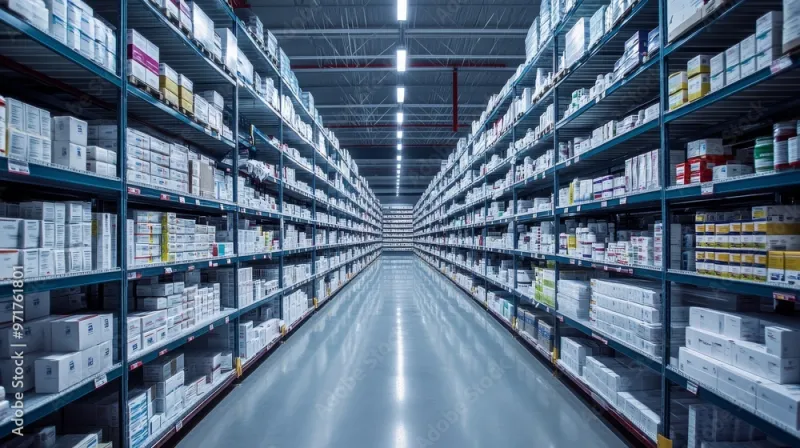
Photo: pharmaceutical warehouse shelves with medication boxes logistics, via as1.ftcdn.net
The Assumption Most Men Never Question
There's a persistent belief among American consumers that medication purchased locally is somehow 'fresher' than anything shipped internationally. The logic feels intuitive: the pharmacy is ten minutes from your house, so the pills must be newer. But pharmaceutical freshness isn't measured in miles—it's measured in months between manufacture and consumption, and in the conditions the product endured along the way.
When you actually map both journeys, the assumptions start to fall apart.
The American Distribution Maze
Consider the typical path a generic medication takes through the US supply chain. After leaving a manufacturer—often one located overseas to begin with—the product enters a wholesale distribution network that resembles a game of hot potato. Primary wholesalers receive bulk shipments, then distribute to regional depots in places like Memphis, Louisville, or suburban New Jersey. From there, stock may pass to secondary wholesalers before landing at your local pharmacy.
Industry analyses have repeatedly found that prescription drugs in the United States can sit in this distribution pipeline for six months to a year or more before reaching a dispensing shelf. A bottle of tadalafil on your neighborhood pharmacy's shelf may have been manufactured well over a year ago, with its two-to-three-year expiration window already substantially consumed before you ever swallow a tablet.
Add another wrinkle: pharmacies themselves. Independent drugstores and even some chain locations don't always turn over high-volume stock quickly. A slower-moving medication in a small-town pharmacy may linger in the dispensing cabinet for additional months.
The Direct-From-Source Alternative
Now trace the other path. A tadalafil shipment dispatched from a Hong Kong-based pharmacy to a customer in Texas travels roughly fourteen hours by air, plus a few days of customs processing and domestic handoff. The total transit time, in most cases, is under two weeks.
The product inside that package was typically manufactured far more recently than warehouse-aged domestic stock. Reputable international pharmacies source from WHO-GMP-certified manufacturers and ship in quantities tied to actual orders rather than speculative wholesale inventory. There is no regional depot, no secondary wholesaler, no shelf in a strip mall. The supply chain is short, and short supply chains mean less elapsed time.
Storage Conditions Matter More Than Proximity
Elapsed time is only half the equation. Tadalafil's potency depends heavily on how it's stored—stable room temperature, low humidity, protection from light. Here, too, the comparison is less one-sided than consumers assume.
US distribution warehouses are generally climate-controlled, but products may sit in loading docks, delivery trucks in Arizona summer heat, or pharmacy stockrooms of variable quality. Direct international shipments, by contrast, are typically sealed in manufacturer blister packaging—individual foil cavities that protect each tablet from moisture and light until the moment of use. Blister packaging is, frankly, superior protection to a shared amber bottle that gets opened and closed for months.
Reading the Expiration Date Like an Insider
Here's the practical takeaway for any buyer: the expiration date is only meaningful in relation to when you start taking the medication. A tablet expiring in fourteen months that you begin using next week offers more usable lifespan than a tablet expiring in eighteen months that already sat in a warehouse for a year.
Always check the manufacturing date and expiration date printed on packaging—legitimate suppliers print both. If a seller can't or won't provide this information, that itself is a red flag. But don't equate a longer trip with an older pill. In the modern pharmaceutical economy, the shortest supply chain often delivers the newest product.
'Closeness' is a comfort, not a chemistry. What preserves potency is time, temperature, and packaging—and on those metrics, a well-run direct shipment can outperform the pharmacy down the street.